July 13, 2026
Why stolen passwords are still the #1 way businesses get hacked, and what we're doing about it
By Matt Urbanski, Big U Computers
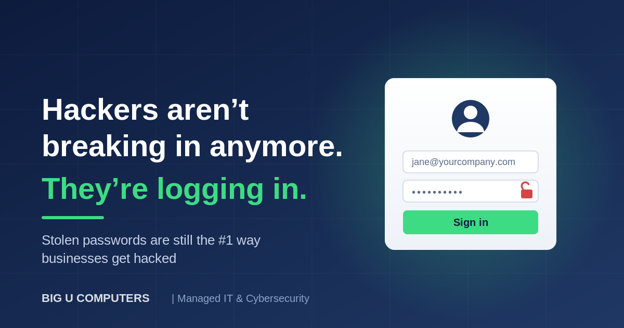
When most people picture a hacker, they imagine someone in a hoodie furiously typing code, smashing through firewalls like a burglar kicking down a door. The reality in 2026 is far less dramatic, and far more dangerous: today's attackers don't break in. They log in, using a real username and a real password that belongs to someone at your company.
No alarms. No broken glass. Just a quiet login that looks exactly like you.
The numbers are hard to ignore
A recent industry report from Guardz, built on six months of security data from small and midsize businesses just like yours, found that 89% of the small businesses they monitored had at least one employee with a confirmed compromised password at any given time. Roughly 1 in 3 users had a password floating around in criminal hands at some point during the study.
This isn't one vendor waving a scary flag, either. Verizon's annual Data Breach Investigations Report, the most respected study in the industry, found that stolen or abused credentials show up in 39% of breaches, making them the single most common ingredient in successful attacks. And Microsoft reported that identity-based attacks (attacks aimed at your logins rather than your computers) jumped 32% in just the first half of last year.
Put simply: your passwords are the front door, and criminals are checking the knob every single day.
How passwords get stolen in the first place
Most stolen passwords come from a handful of sources:
Phishing. Fake emails and login pages have gotten scary good. AI has erased the typos and awkward grammar we all used to rely on to spot a scam. Modern phishing emails read like they came from a real coworker or vendor.
Password reuse. If an employee uses the same password for work email and, say, an online store that gets breached, criminals will try that password everywhere. This is why one shopping site's breach can become your business's problem.
The dark web. Once a password leaks, it gets packaged and sold to other criminals on hidden marketplaces. Your credentials may be for sale right now without anyone at your company clicking a single bad link recently.
Why MFA alone is not the whole story
Multi-factor authentication (those codes or push notifications on your phone) is still essential, and every one of our clients should have it turned on everywhere. But attackers have adapted. The newest phishing kits sit invisibly between you and the real Microsoft or Google login page. You type your password, approve the MFA prompt, and log in normally, while the attacker silently captures your active session and rides in right behind you.
The Guardz report also counted more than 114,000 successful sign-ins where MFA was bypassed entirely through outdated connection methods that many businesses never got around to turning off. This is exactly the kind of quiet housekeeping we handle as part of managing your environment: shutting the side doors most people don't know exist.
The real cost: it usually ends in a wire transfer or ransomware
Here's what makes stolen credentials so dangerous: nothing happens right away. Attackers log in and wait, sometimes for weeks, reading email, learning who pays the bills and how. Then, at just the right moment, they slip into a real payment conversation and change the bank account number. One documented case in the Guardz report played out over seven weeks and cost the victim $1.5 million, without a single piece of malware ever touching a computer.
The ransomware connection is just as real. Verizon found that half of ransomware victims who had a leaked credential were hit within about three months of that leak. A stolen password today is often the opening move in a ransomware attack next quarter.
What we're doing, and what you can do
Protecting your logins is already baked into how we manage your IT: monitoring for suspicious sign-ins, phishing protection, security awareness training for your team, and watching the dark web for your company's credentials. On your end, three habits make a real difference: use a unique password for every account (a password manager makes this painless), never approve an MFA prompt you didn't trigger yourself, and slow down on any email that asks to change payment details. Verify by phone, using a number you already have.
Find out if your passwords are already out there
Here's the uncomfortable truth from that 89% statistic: the odds are good that at least one password from your company is already circulating on the dark web. The good news is that finding out is easy.
We'll run a free dark web scan on your company's domain and show you exactly which employee credentials have been exposed, from which breaches, and what to do about it. No cost and no obligation, just a clear picture of where you stand. We'll have your results back to you quickly, explained in plain English, like always.
Ready to see where you stand? Grab 15 minutes on my calendar and we'll get your free dark web scan started. No sales pitch, just answers.
Sources
Guardz, 2026 State of MSP Threat Report (guardz.com) · Verizon, 2026 Data Breach Investigations Report (verizon.com/business/resources/reports/dbir) · Microsoft, Digital Defense Report 2025 (microsoft.com)