November 17, 2026
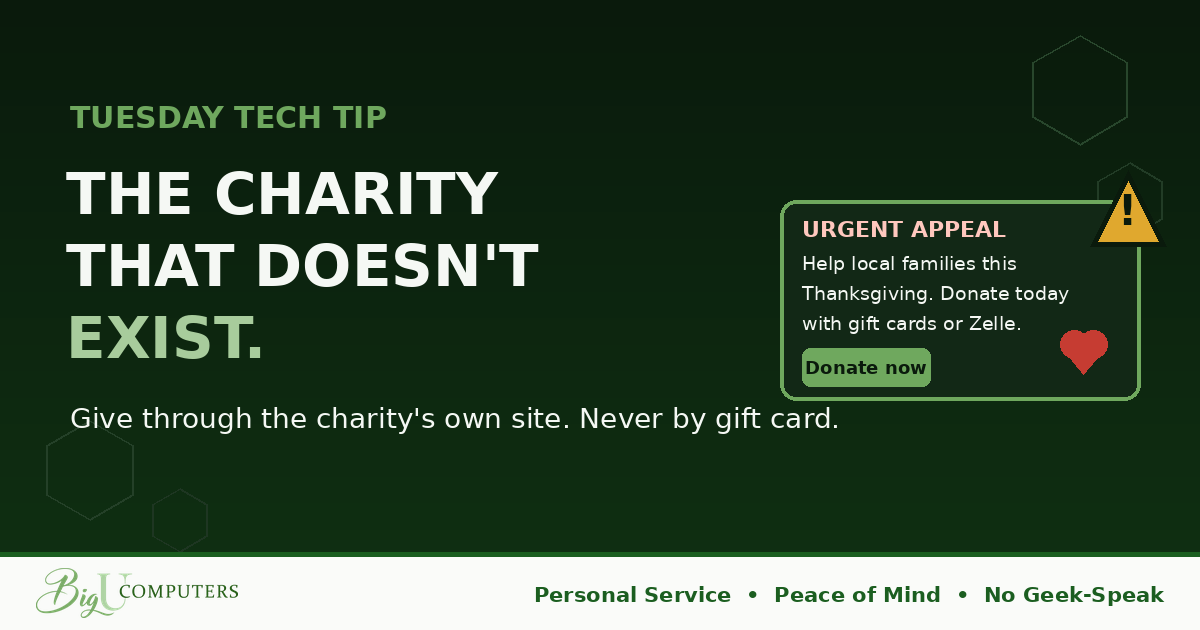
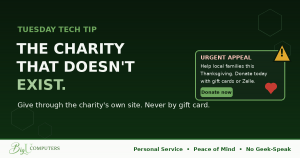
The email arrives the week before Thanksgiving. A photo of a family at an empty table. "This year, 1 in 6 local families will go without a holiday meal. $25 feeds a family of four. Donate now." There's a name that sounds like a real organization, a logo, and a big green button.
You want to help. That's the whole point. Scammers don't exploit greed in November. They exploit generosity, because there's a lot more of it around.
Three Flavors of Fake
- The invented charity. A name that sounds established ("National Veterans Relief Foundation," "Children's Holiday Hope Fund"), a website built last month, and a donation page that collects your card and nothing else. Often they appear within days of a disaster or a news story.
- The lookalike. A name one word off from a real, well-known charity, with a copied logo. Your donation goes to the copycat, and the real organization never sees it.
- The workplace drive. An email that appears to come from the owner or a manager: "We're doing a holiday drive for a local shelter. Can everyone pick up a few $50 gift cards and email me the codes? I'll collect them by Friday." This is the fake-boss scam from August with a charitable costume. It works because refusing feels ungenerous.
The Tells
- Pressure and emotion together. Real charities want your support all year. A countdown, a matching deadline expiring tonight, or an ask that feels designed to make you feel guilty for hesitating is a signal to slow down.
- Gift cards, wire transfers, Zelle, or crypto. No legitimate charity asks for these. They take credit cards and checks, and they issue receipts. Anyone asking for gift card codes is not running a charity.
- Vague specifics. "Local families" without saying where. "Veterans" without a program. A real organization can tell you exactly what your $25 does.
- A link in a message you didn't ask for. The appeal arrived by text, email, or a stranger's social post. That's not how you find a charity. That's how a charity finds your card.
How to Verify in Two Minutes
Search the charity's name on Charity Navigator, GuideStar, or the Better Business Bureau's Give.org. Real registered nonprofits appear there with financial details. You can also search your state's charity registry; in Pennsylvania, the Bureau of Corporations and Charitable Organizations lists every registered charity. If the name doesn't appear anywhere, it isn't a charity.
Then, if you want to give, go to the charity's own website by typing its address or by clicking through from the rating site. Never donate through the link in the message. Even if the charity is real, the link might not be.
The Habit
Decide who you want to support, then go find them. Don't let them find you. The generosity is the same. The direction is reversed, and that reversal is the whole defense.
For the workplace version, apply the Call-Back Rule: any request from "the boss" involving gift cards or money gets verified in person or by calling their known number. A real manager running a real drive will be glad you asked.
If You Already Gave to a Fake
If you paid by credit card, call the card company and dispute it as fraud. If you sent gift card codes, contact the card issuer immediately; the odds are slim but not zero if it's fast. Report it to the FTC at reportfraud.ftc.gov so the pattern gets tracked. And don't let it stop you from giving. Just give on your own terms, to organizations you looked up yourself.
Owners: Make the Real Drive Obvious
If your company runs a genuine holiday collection, announce it in person or at a staff meeting before any email goes out, name the person collecting, and never ask for gift card codes by email. When your team knows exactly what the real thing looks like, the fake one has nothing to hide behind.
Want to talk through the rest of your holiday season security, from short-staffed weeks to year-end invoices? Book 20 minutes with me here. Personal Service, plain English.
Big U Computers, LLC. Personal Service, Peace of Mind, No Geek-Speak, and We Won't Hold You Hostage. That's the promise.