
November 24, 2026
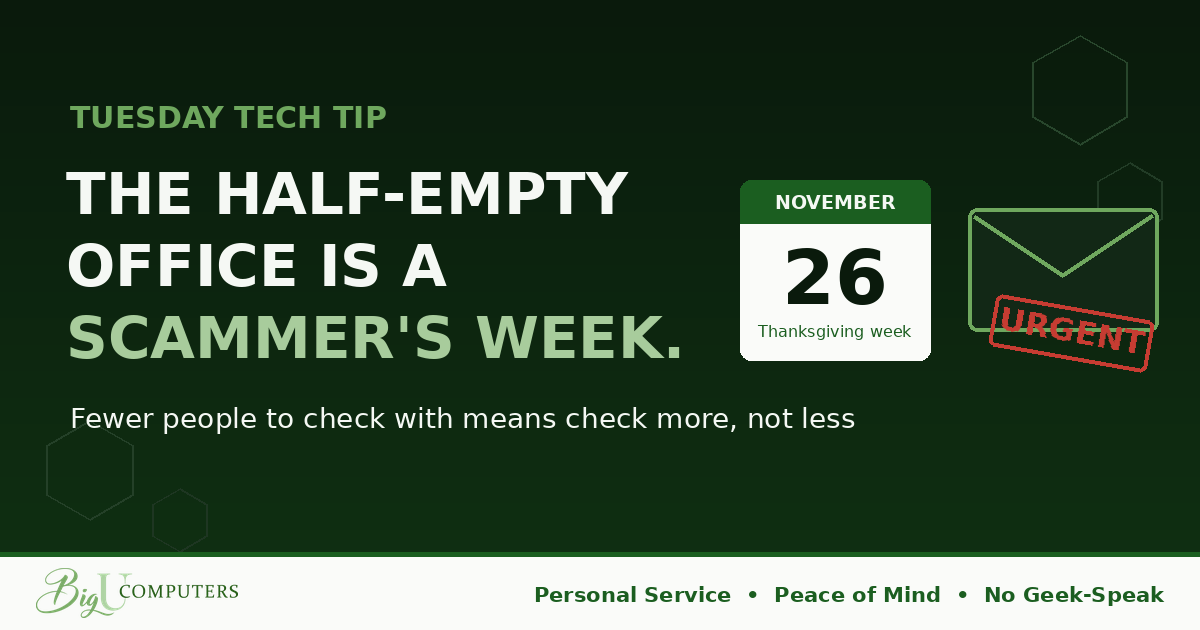
Every business has a week like this one. The owner's traveling. The bookkeeper took Wednesday through Friday. The new hire is covering the front desk and the inbox. Everyone still in the building is trying to finish three things before noon on Wednesday.
If you were a criminal, when would you send the fake invoice?
Why This Week Works for Them
Scams need three things to succeed: a plausible request, pressure to act fast, and nobody available to check with. Most of the year, that third ingredient is the hard one. This week, the calendar supplies it.
So the requests arrive on schedule. An invoice marked "final notice, must process before the holiday." A vendor emailing that their bank details changed and the payment needs to go out today. A text from the boss, who is conveniently traveling and can't take calls, asking someone to handle something quickly and quietly. Every one of them is designed for a person who is covering an unfamiliar job with nobody to ask.
The Rule: Verify More, Not Less
The instinct when you're short-staffed is to be helpful and keep things moving. Reverse it. When fewer people are around to check with, checking matters more, and the bar for acting without it should go up, not down.
Concretely: every request that involves money, banking details, passwords, or urgency gets verified by calling a known number, the Call-Back Rule from July. If the person who can verify it is out, the request waits for them. That's not a failure. That's the system working.
Here's the sentence to keep in your head all week: nothing real breaks because it waited until Monday. Real vendors understand holidays. Real bosses would rather a payment be three days late than gone forever. The only requests that can't survive a wait are the fake ones.
The Fort-Holder's Checklist
If you're the one covering this week, print this and keep it by the keyboard:
- Any request to pay, change bank details, buy gift cards, or share passwords: stop and call a known number. No exceptions for urgency.
- The person who normally approves it is out? Then it waits. Reply: "I'll have this handled when they're back on Monday."
- A message from the boss that can't be verified by calling the boss's real number is not from the boss.
- Unexpected sign-in prompts, weird pop-ups, or a link you clicked and regret: tell whoever's covering IT within 60 seconds. Holiday week doesn't pause that rule.
- Lock your screen when you step away, even if the office feels empty. Especially then.
Owners: Say It Before You Leave
The single most useful thing you can do before heading out is tell whoever's covering, in plain words: "If anything involving money or accounts comes in while I'm out, it waits for me. I will never be upset that something waited. Call me if you're unsure, and if you can't reach me, the answer is no until Monday." That sentence removes the pressure the scam depends on.
This is what Personal Service looks like in practice: not just fixing computers, but making sure the people using them feel safe saying "not today."
Two weeks of December tips left, then we pause for the holidays. If you'd like to start the new year knowing exactly where your team stands, we run friendly phishing simulations that show it. Book 20 minutes with me here. Happy Thanksgiving from all of us.
Big U Computers, LLC. Personal Service, Peace of Mind, No Geek-Speak, and We Won't Hold You Hostage. That's the promise.