September 14, 2026
For aspiring business leaders and early-stage founders, the hardest part often isn’t working harder, it’s realizing effort can’t compensate for unclear leadership. When business leadership qualities are inconsistent, teams second-guess decisions, culture drifts, and execution slows, even when the product and strategy look solid. The effective leadership impact shows up quietly in how priorities get set, how conflict gets handled, and how people perform when no one is watching. Clarifying the leadership characteristics importance helps entrepreneur leadership traits become a steady force that shapes results.
Understanding the Leadership Traits That Matter
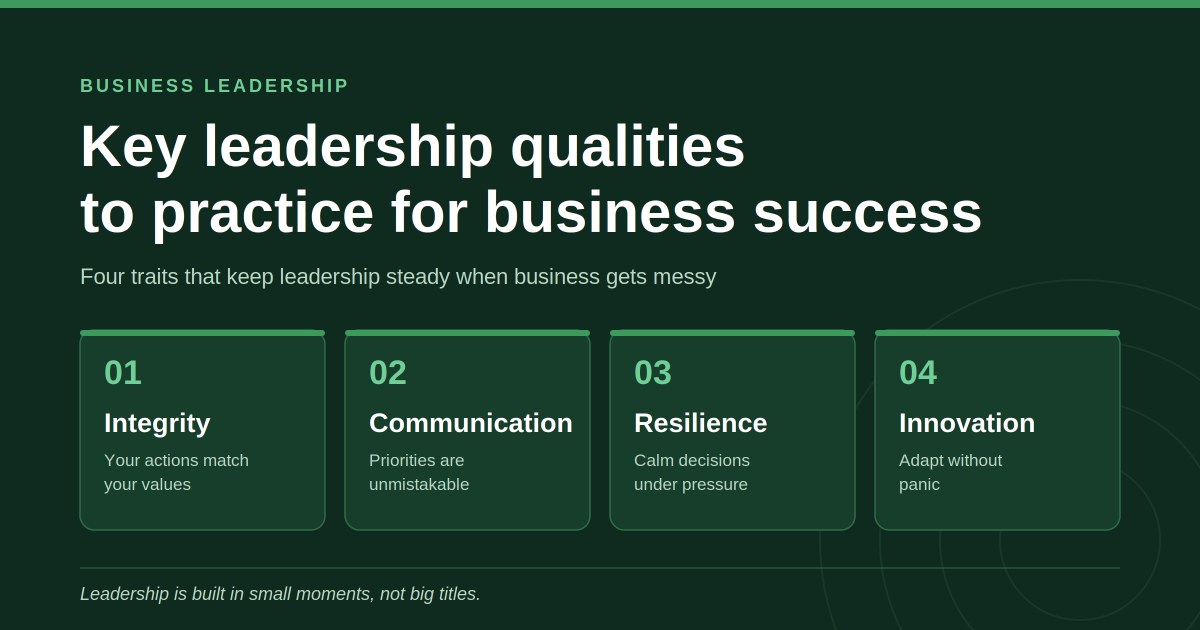
Integrity, clear communication, resilience under pressure, and innovation are the four traits that keep leadership steady when business gets messy. Integrity means your actions match your values, communication makes priorities unmistakable, resilience keeps you useful in stress, and innovation helps you adapt without panic. These qualities shape outcomes people can feel. When pressure hits, resilience becomes the difference between calm decisions and reactive ones, and 61% of surveyed business leaders say it matters most for success.
Picture a missed deadline: a leader with integrity owns the gap, explains the plan, protects the team, and still looks for a smarter approach. That blend is why many founders study leaders like Satya Nadella, who rebuilt trust, clarified direction, and pushed Microsoft to keep learning, and click here to read more about leadership examples that highlight these traits in action. These traits become practical through emotional intelligence, smart delegation, and simple decision habits.
Lead with Reliable Technology
Strong leadership means giving employees the tools they need to perform their jobs efficiently, and that starts with dependable computers and IT systems. Slow, outdated, or unreliable technology can interrupt workflows, reduce productivity, and leave employees frustrated. Business leaders should prioritize reliable hardware, regular maintenance, cybersecurity, and responsive technical support to keep operations running smoothly. Companies such as Big U Computers provide managed IT services and ongoing support designed to help businesses maintain efficient, secure technology environments.
Practice Better Leadership: 7 Moves You Can Use This Week
Leadership traits like integrity, clear communication, resilience, and innovation sound big, but they become real through small choices you repeat. Here are daily leadership practices you can start this week to make leadership skill development feel practical, not theoretical.
- Run a 2-minute “temperature check” before you respond: When a message triggers you, pause and label what you’re feeling (frustrated, rushed, defensive) and what outcome you want (clarity, alignment, commitment). This tiny step is the backbone of building emotional intelligence because it reduces reactive replies and protects trust. I’ve found my tone improves immediately when I decide whether the goal is to solve, support, or set a boundary.
- Turn “clear communication” into a one-sentence brief: Before assigning work or sharing an update, write one sentence that answers: What are we doing, by when, and what does “done” look like? Then deliver it verbally or in writing, and ask the other person to repeat it back in their own words. This prevents the “we agreed, but we didn’t agree” problem and makes integrity visible through follow-through.
- Delegate by outcome, not by task list: Choose one responsibility you’re holding that someone else could own and delegate it with three elements: the outcome, the constraints (budget, quality bar, must-ask-me-before decisions), and the check-in rhythm. Strong delegation strategies create accountability without micromanaging, and they also build resilience by reducing single-person bottlenecks. If you’re unsure, start with a low-risk item you can review in 48 hours.
- Use a simple decision filter for faster, calmer calls: For everyday decision-making techniques, ask three questions: Is this reversible? What’s the cost of waiting one more day? Who has the closest information? If it’s reversible and waiting costs more than acting, decide quickly and document the why in two lines so the team learns your logic. This keeps momentum high without sacrificing thoughtful judgment.
- Practice the “integrity loop” when you can’t deliver: The moment you suspect you’ll miss a deadline or expectation, send a short update: what changed, what you’re doing now, and the new commitment date. People can handle bad news better than surprise, and this habit strengthens psychological safety. It’s a small move that protects your credibility under pressure.
- Build innovation into the week with one controlled experiment: Pick a process pain point and run a 7-day micro-test with a measurable target (e.g., reduce handoff delays by one day, cut meeting time by 15 minutes). Decide in advance what data you’ll watch and what would make you keep, tweak, or drop the change. Innovation feels less risky when it’s time-boxed and evaluated like any other work.
- End the week with a 10-minute leadership review: Write three bullets: one decision you’d repeat, one conversation you’d handle differently, and one person to develop next week. This reflection matters because organizations invest an estimated USD 60 billion annually in leadership development, and your personal system is what turns “development” into results. If you want extra motivation, remember that 86% of employees believe effective leadership is crucial for career growth and job satisfaction, your improvements land directly with real people.
Leadership Habits You Can Repeat Every Week
Leadership qualities stick when they live in your calendar, not just your intentions. These habits turn integrity, adaptability, and resilience into small actions you can repeat until they become your default.
Two-Line Accountability Note
- What it is: Write one expectation and one follow-up date using establishing accountability.
- How often: Per new assignment.
- Why it helps: It reduces confusion and makes ownership visible without policing.
Daily “One Priority” Reset
- What it is: Pick one outcome for today and say no to one distraction.
- How often: Daily.
- Why it helps: It protects focus when demands pile up.
Delegate One Decision
- What it is: Hand off a decision plus guardrails, then let it stand.
- How often: Weekly.
- Why it helps: It lowers cognitive load and builds trust through autonomy.
Adaptability Reframe Log
- What it is: Rewrite one setback as a next experiment, since leadership defined by adaptability is the new baseline.
- How often: Weekly.
- Why it helps: It strengthens resilience and keeps you learning in motion.
Leadership Qualities FAQs: Confidence and Tough Calls
Q: What if my confidence drops the moment I have to lead?
A: Confidence is often a byproduct of repetition, not a personality trait. Treat leadership as a skill you practice on purpose, because leadership is a teachable skill. Pick one small leadership action today, like clarifying the outcome, then reflect on what improved.
Q: How do I make a tough decision when I’m afraid of being wrong?
A: Define the decision window, list two realistic options, and choose the one that best protects the core goal. A leader learns in motion, and the idea that an indecisive leader is an oxymoron is a useful nudge toward clarity. After you decide, communicate the “why” in one sentence.
Q: What if I’m new and feel like I don’t have the skills yet?
A: Start with fundamentals that do not require a title: listening well, setting clear expectations, and following through. Ask for feedback on one behavior, not your whole leadership style. Then practice it for a week before you add something new.
Q: When should I delegate instead of trying to prove myself?
A: Delegate when the task is repeatable, when someone else can learn it safely, or when your time is better spent removing obstacles. Give a clear outcome, boundaries, and a check-in point. You still lead by coaching the result, not by holding every step.
Q: Why do I feel guilty holding people accountable?
A: Accountability is clarity, not punishment, when you pair expectations with support. Use neutral language, confirm what “done” looks like, and set a specific follow-up date. Most tension fades when people know exactly what success is.
Turn Leadership Qualities Into Consistent Business Success
Even strong leaders hit moments where confidence dips, tough calls stall, and good intentions don’t translate into action. The way through is a steady, principles-first approach: practice key leadership qualities with a growth mindset in leadership, and treat each challenge as feedback, not a verdict. Over time, applying leadership skills this way builds calm decision-making, clearer communication, and trust, leadership success factors that compound. Leadership is built in small moments, not big titles.