September 8, 2026
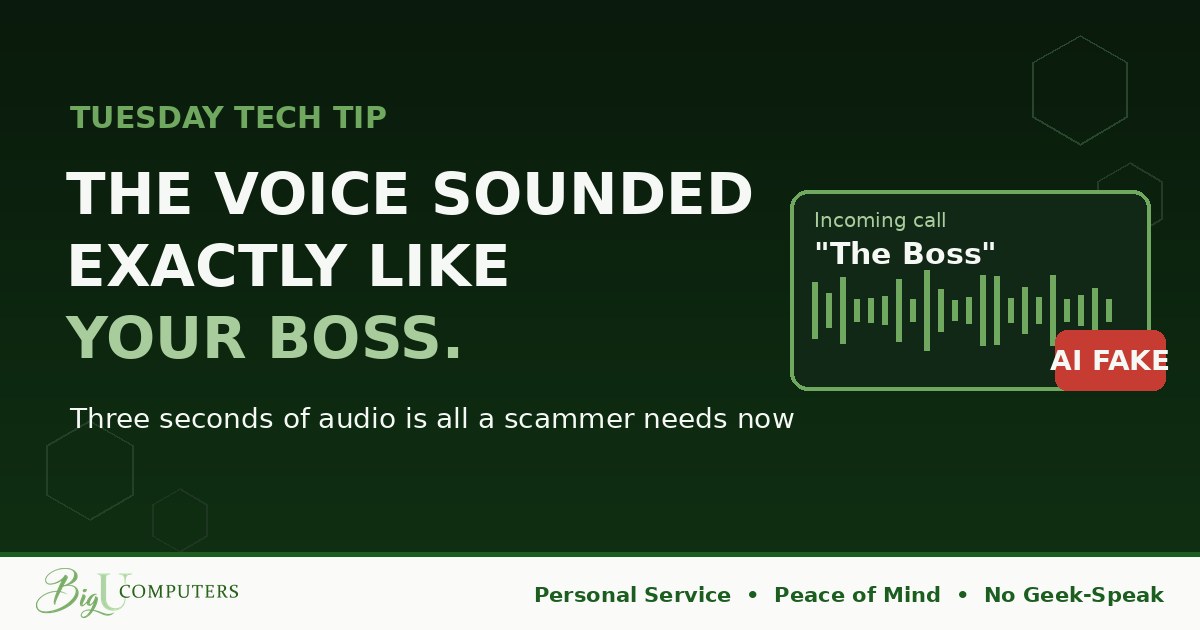
Your desk phone rings at 4:15 on a Friday. It's your boss. Not a text this time, an actual call, and it's unmistakably her voice: the pace, the slight rasp, the way she says your name.
"I'm stuck at the airport and my card just got declined. I need you to buy three $500 gift cards and text me the codes so I can sort out this hotel. I'll explain Monday. Please don't bother anyone else with this, it's embarrassing enough."
That was not your boss. That was software.
How Voice Cloning Actually Works
A few years ago, faking someone's voice took a studio and a lot of time. Today it takes a laptop and a short audio sample. Three to ten seconds is enough. And that sample is easy to find: a voicemail greeting, a video on your company's website or social media, a podcast appearance, a recorded webinar, even a TikTok.
The software learns the voice and then reads whatever script the scammer types. Tone, accent, breathing, all of it. On a phone line, with a little background noise, it is close enough to fool the people who know that voice best.
The scammers pair it with the same research we talked about last month: names from your website, roles from LinkedIn, and a good guess about who is new, eager, and unlikely to push back.
What the Call Sounds Like
- A familiar voice with a plausible crisis: stuck traveling, in a meeting with a client, locked out of accounts, dealing with a family emergency.
- A request that involves money, gift cards, wire transfers, passwords, or access: "read me the code that just texted you."
- Urgency and secrecy: it has to happen now, and please don't tell anyone.
- A reason they can't be reached normally: new number, dead phone, bad signal, "call me back on this line only."
Every one of those is a pressure tactic, and the familiar voice is there to make you skip the step that stops it.
The Updated Rule
Last month's rule was "verify by voice." Here's the upgrade: a familiar voice is no longer proof of anything. What counts is a voice on a line YOU dialed.
For any request involving money, passwords, codes, or secrecy: say "I'll call you right back," hang up, and call the person at the number you already have saved. Not the number on your caller ID, which can be faked too. The one in your contacts, or on the company directory.
If it was really them, you'll be connected in 30 seconds and they'll respect that you checked. If it wasn't, the real person will have no idea what you're talking about, and that's your answer.
The Five-Minute Team Safe Word
Here's a defense that beats even perfect voice cloning: a safe word. Your team agrees on a word or phrase that anyone requesting money, gift cards, or sensitive information over the phone must say. An inside joke works great. The name of the office plant. Something a stranger could never guess and would never find online.
Set it at your next staff meeting. Tell everyone: no safe word, no action, no matter how real the voice sounds. Scammers can copy a voice. They can't copy a shared memory.
If a Call Like This Already Got Through
Stop contact. Tell your manager and whoever handles your IT immediately. If gift card codes went out, contact the card issuer; sometimes funds can still be frozen if it's fast. And remember that these calls fool people precisely because they're good. Speed matters, blame doesn't.
Want your team to practice this before a real call comes in? We run friendly simulations and plain-English training for businesses across the region. Book 20 minutes with me here and I'll walk you through it. Personal Service, No Geek-Speak.
Big U Computers, LLC. Personal Service, Peace of Mind, No Geek-Speak, and We Won't Hold You Hostage. That's the promise.